
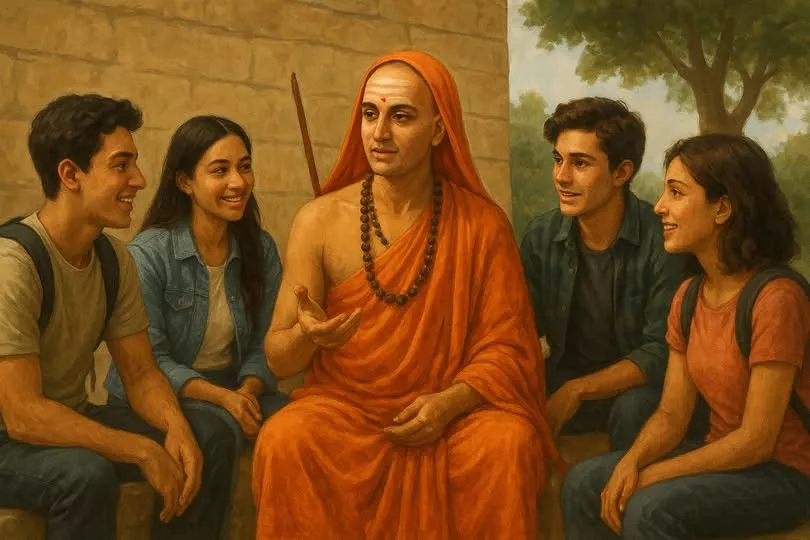
In the traditions of ancient India, scholars cherished the art of the Ek Sloka — a single verse that condenses the essence of an entire scripture or monumental text. To compose one required not only poetic mastery, but also a deep and thorough understanding of the work itself. It was an act of distillation: extracting the purest essence of vast knowledge into a few lines of profound meaning.
The Bhagavad Gita has its own Ek Sloka, so does the Mahabharata and the Ramayana - entire text summarized in just one Shloka. Isn’t it amazing? Among the most celebrated examples are those composed by Adi Shankaracharya, whose verses capture timeless truths with stunning clarity. One of my favorites is the Eka Shloki by Adi Shankaracharya, which captures the essence of Vedantic philosophy.
Adi Shankaracharya’s Eka Shloki:
किं ज्योतिस्तव भानुमानहनि मे रात्रौ प्रदीपादिकम्
स्यादेवं रविदीपदर्शनविधौ किं ज्योतिराख्याहि मे ।
चक्षुस्तस्य निमीलनादिसमये किं धीर्धियो दर्शने
किं तत्राहमतो भवान् परमकं ज्योतिस्तदस्मि प्रभो ॥
Meaning:
Teacher: How do your see?
Student: I see with the help of sunlight.
Teacher: How do you see in the night?
Student: I see by the light of a lamp.
Teacher: How do you see the light ? How do you see even before you open your eyes?
Student: I see with my intellect.
Teacher: What helps you see that intellect?
Student: It is I.
Teacher: Then, you are that supreme light.
Student: I realize that I am!
In our times, we are fascinated by artificial intelligence and its abilities. It is sometimes used to automatically generate summaries of long texts. Yet, can it ever match the depth and insight of those ancient sages who distilled lifetimes of wisdom into a single sloka? A machine can compress text, but an Ek Sloka reveals the heart of it.
This practice was not only about summarizing texts, but also about identifying what truly matters. By stripping away the unnecessary, the Ek Sloka shines light on the essential. That is why it still speaks to us today.
In modern life, we too are surrounded by clutter — distractions, noise, and unending desires — often leading us nowhere. But what if we had our own Ek Sloka? A guiding verse, a compass pointing us back to what is most important: inner growth, truth, and self-realization.
And then the question lingers, quietly yet powerfully — what is my Ek Shloka ?